

Web Development Agency in Egypt: How to Choose One in 2026
A practical guide to choosing a web development agency in Egypt in 2026: what to expect on bilingual design, speed, data law and ownership, plus seven questions to ask.
Articles
A company website in Egypt now does far more than introduce the business. It answers procurement teams, takes orders, books appointments, collects leads and connects to the systems behind them. For a holding company, a clinic network or a growing retailer, that makes the choice of a web development agency in Egypt a commercial decision, not a design exercise.
It is one part of the brief covered in our guide to marketing agencies in Egypt. Here we look only at the website: the scope a serious build needs, the standards to hold it to, and the questions that separate a sound build from an expensive rebuild.




Why the Website Carries More Weight in Egypt
The audience is online and mostly on mobile. DataReportal’s Digital 2026 report for Egypt counts 98.2 million internet users at the end of 2025, or 82.7 per cent of the population, and 121 million mobile connections. Median mobile download speeds reached 56.45 Mbps, according to Ookla data cited in the same report.
Spending online is following. Egyptian e-commerce reached an estimated US$2.34 billion in revenue in 2025, according to ecommerceDB, and digital payments are now routine for millions: the Central Bank of Egypt’s governor told the 12th PAFIX conference that Meeza wallets number 55.5 million and InstaPay has 16 million users.
The practical meaning is simple. A site that loads slowly on a phone, or cannot take a local payment, loses business it never sees. Any agency quoting for a transactional site should explain how it will handle mobile performance and local payment options from the first workshop.
What a Web Development Agency in Egypt Should Deliver
A website project is often priced as design plus code. A build that lasts needs six things done properly.
Discovery and scope
Good projects start with questions, not mockups. Who uses the site, what must they be able to do, which systems must it connect to, and how will success be measured? The answers become a written scope with priorities, so the first release covers what matters most.
Bilingual design built for Arabic
Most Egyptian brands need Arabic and English, and Arabic is not a translation layer. Right-to-left layouts change navigation, forms, tables and image direction. The site should be designed in both languages from the start, with Arabic typography chosen as carefully as the Latin.
Engineering that stays maintainable
The site should run on a stack the client can host, update and hand to another team if needed. Ask how content is edited, how updates are tested and released, and who owns the code and the domain.
Performance measured against Google’s standards
Google’s Core Web Vitals set clear targets: Largest Contentful Paint within 2.5 seconds, Interaction to Next Paint of 200 milliseconds or less, and Cumulative Layout Shift of 0.1 or less, measured at the 75th percentile of page loads. Interaction to Next Paint replaced First Input Delay as a Core Web Vital on 12 March 2024, according to web.dev. A capable partner designs to these numbers rather than testing for them at the end.
Accessibility
WCAG 2.2 became a W3C Recommendation on 5 October 2023. Accessible forms, readable contrast, keyboard navigation and clear headings help people with disabilities and usually improve the site for everyone else.
Security and integrations
Corporate sites connect to CRMs, booking engines, payment gateways and analytics. Each connection needs secure handling of credentials and data, and a plan for what happens when an outside service fails. Ask how often software updates are applied and who is alerted if the site goes down.
Mobile Comes First, Including for Google
Google completed its move to mobile-first indexing in July 2024, according to Google Search Central, which means it reads and ranks the mobile version of a site. A desktop site with a cut-down mobile view now underperforms in search as well as with customers.
For buyers, the test is simple. Review every proposed page on a mid-range phone, on a mobile connection, before approving design. An agency that presents desktop mockups first is planning in the wrong order.
Search Visibility Starts in the Build
Search performance is decided as much in the build as in later marketing. Page titles, headings, clean addresses, internal links, structured data and fast mobile pages all live in the code and the templates. Bilingual sites also need correct language tags, so Google shows Arabic pages to Arabic searchers and English pages to English ones.
Replacing an existing site carries a specific risk. Every old address that earned links or rankings needs a permanent redirect to its new equivalent, or that value is lost on launch day. Ask for a redirect map before the old site is switched off, and for a review of search traffic in the weeks after launch.
Google states that its standard SEO best practices also apply to AI Overviews and AI Mode. A site built properly for search is therefore better placed to be cited in AI answers too.
Websites for Corporate, Healthcare and Government Clients
Each sector asks something different of a site. Corporate groups need credibility for procurement and investors, with clear routes to the profile, projects and contacts. Healthcare providers need accurate service information, appointment routes and careful handling of patient enquiries. Government bodies need accessibility, Arabic first and a strict approval process for every update.
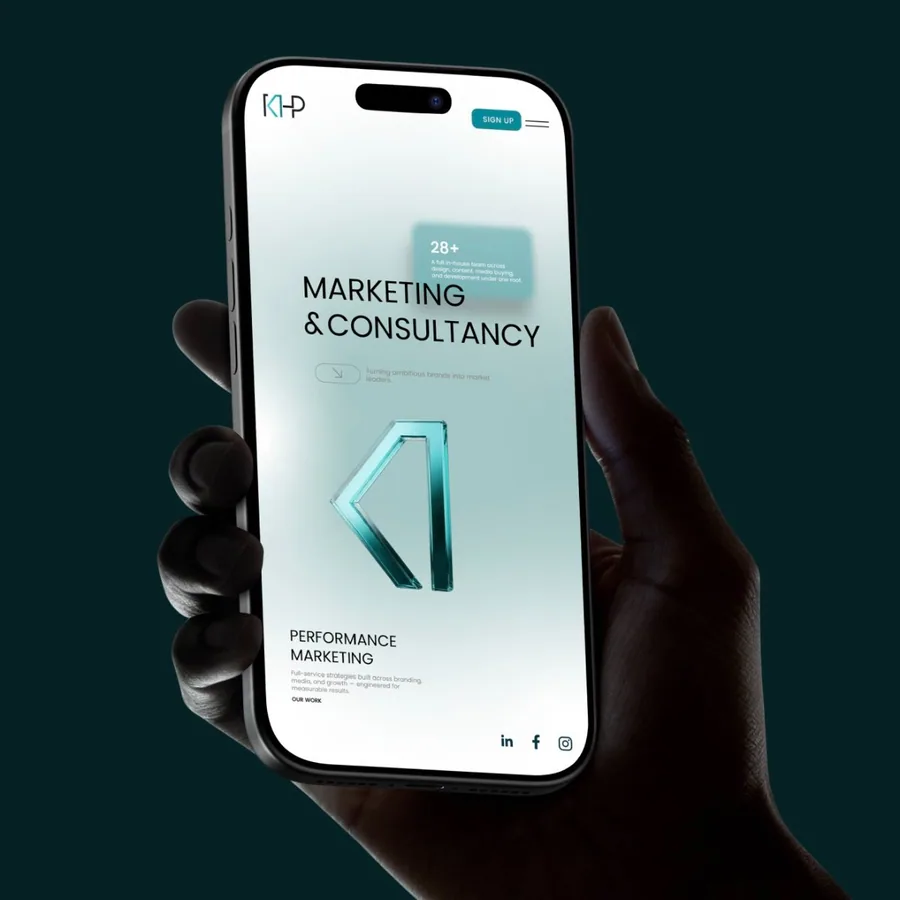
KHP has built websites for clients in construction, export, shipping and healthcare. For the Egyptian contractors ACME (case study) and iGroup Construction (case study), the sites state what each company offers and route visitors to its projects, services or a consultation from the first screen. For the exporter El Manar International (case study), the site runs in English, Spanish and Arabic for buyers abroad. For Eldawi Sons (case study), a Cairo shipping agency established in 1976, the site sets the agency’s core services across its first screen, so ship owners see the full offer at once. For Human Care (case study), a healthcare brand in Qatar, KHP built a multi-label brand system.
When assessing a web development agency in Egypt for sector work, ask to see live sites from your sector, not screenshots, and test them on your own phone.
Data, Hosting and Ownership
Every contact form, booking and account on a site gathers personal data. Under Egypt’s data protection law (Law No. 151 of 2020), whose Executive Regulations arrived in November 2025 according to Al Tamimi & Company, moving that data abroad and using it for direct marketing both carry specific obligations. Where the site is hosted is therefore a legal question as well as a technical one.
Ask which country the servers sit in, who inside the agency can read form submissions, and where consent is logged. Our own information security and delivery process are certified to ISO 27001 and ISO 9001, but each client should still confirm its obligations with its own lawyers.
Ownership matters as much. The client should hold the domain, hosting account, code repository, analytics and every licence from the first day.
Seven Questions for Any Website Proposal
Use these questions to compare any web development agency in Egypt on equal terms.
- Who will build the site? Meet the designer, the developer and the project lead, not only the people who pitch.
- How is Arabic handled? Ask to see right-to-left layouts from past projects.
- What are the performance targets? Ask for Core Web Vitals goals in writing.
- Who owns what? The domain, hosting, code and analytics should sit with you.
- How is content edited? Ask for a demonstration of the editing interface.
- How is the site tested? Ask about browsers, devices, accessibility and security checks before launch.
- What happens after launch? Agree support hours, response times and the cost of changes.
Frequently Asked Questions
How should a company budget for a web development agency in Egypt?
Ask each agency to price discovery, design, development, content and ongoing support as separate lines. Integrations and bilingual content usually move the price most, so confirm both are fully scoped before comparing totals.
How long does a corporate website take?
A focused corporate site usually takes weeks, while a platform with accounts, payments or integrations takes months. The timeline should come from the written scope, not from a template.
Does the website belong with the brand and marketing team?
Usually, yes. The site carries the brand identity and receives the traffic marketing pays for, so one team keeps design, content and tracking consistent.
Choosing Your Web Development Agency in Egypt
Egypt’s audience is large, mobile and increasingly ready to pay online. Serving it takes clear scope, bilingual design, measurable speed, accessibility, secure integrations and clean ownership.
A capable web development agency in Egypt will put those standards in writing before the first design is shown. KHP has built websites and platforms since 2018, working from offices in Egypt and Dubai for clients across Egypt, Saudi Arabia, the UAE, Qatar and beyond.
If the website is one piece of a wider brief, our guide to marketing agencies in Egypt covers the rest, and our buyer’s guides to choosing a branding agency in Egypt and a social media marketing agency in Egypt go deeper on those briefs. To talk about your site, start the conversation at khpmarketingagency.com. We create the difference.
Where this thinking turns into work.



Ready to Build Something That Performs?
Tell us about your organisation and what you need to build. We will tell you exactly how we would approach it.